TL;DR: LVP is the best all-around basement flooring for most Utah homeowners because it’s fully waterproof, comfortable, and durable — but the right choice ultimately depends on your moisture levels, budget, and how you plan to use the space.
Key Points
- Basements are below grade, which means moisture resistance is the most critical factor in any flooring decision
- Always test your basement for moisture before installing any flooring
- LVP (luxury vinyl plank) is the most popular and most versatile basement flooring option
- Waterproof laminate is now a legitimate basement option — standard laminate is not
- Carpet can work in dry, well-controlled basements but is a risk in moisture-prone spaces
- Solid hardwood should never be installed in a basement
- Utah’s temperature swings between seasons create expansion and contraction cycles that affect how flooring performs over concrete
- The right flooring depends heavily on how you plan to use your basement
Why Basement Flooring Is Different from Every Other Room
Basements present challenges that no other room in your home does.
They sit below grade, in direct contact with the ground and concrete foundation. That means higher ambient humidity, temperature fluctuations between Utah’s cold winters and warm summers, and the constant possibility of moisture migrating up through the concrete slab even in basements that have never visibly flooded.
The concrete subfloor also changes what installation methods are available. Many flooring types that work perfectly upstairs need vapor barriers, additional subfloor layers, or different installation techniques to perform correctly in a basement.
Getting the flooring right from the start saves you from a costly redo down the road.
Test Your Basement for Moisture Before You Do Anything Else
Before choosing any flooring material, you need to know your basement’s actual moisture level. Don’t skip this step.
Here’s a simple test: Cut a piece of plastic sheeting into a 12-inch by 12-inch square. Tape all four edges securely to your bare concrete floor and leave it for 48 hours. When you peel it up:
- No moisture underneath — your slab is relatively dry and most flooring options are available to you
- Moisture on the underside of the plastic — moisture is migrating up through the concrete, and you need to address this before installing flooring
- Pooling water — you have an active water intrusion issue that requires waterproofing work before any flooring goes in
In Utah’s valley communities, soil composition and seasonal snowmelt can push moisture into basements in ways that aren’t always obvious. A dry basement in August may behave very differently in March. Testing in late winter or spring gives you the most accurate picture.
Best Basement Flooring Option #1: Luxury Vinyl Plank (LVP)
LVP is the clear top choice for most basements, and it’s not particularly close. It’s fully waterproof, comfortable underfoot, works directly over concrete with a moisture barrier, and comes in styles that convincingly mimic hardwood or stone.
It’s also one of the warmest options available for a concrete subfloor, which matters in a basement where cold floors can make an otherwise finished space feel uninviting.
Pros:
- 100% waterproof — the safest choice for any basement moisture environment
- Comfortable and slightly cushioned underfoot, even over concrete
- Installs directly over concrete with a vapor barrier
- Wide range of realistic wood and stone looks
- Budget-friendly compared to tile or engineered hardwood
- Can be removed and reinstalled after a flood event
- Works for every basement use case: family room, bedroom, home office, gym
Cons:
- Cannot be refinished if damaged — planks must be replaced
- Lifespan of 15 to 25 years (shorter than tile)
- Heavy appliances or furniture can dent lower-quality vinyl
- Does not add the same resale value as hardwood
Cost range: $4 to $10 per square foot installed
Best for: Nearly every finished basement application. If you’re unsure what to choose, LVP is the right default.
Explore our luxury vinyl plank flooring options to find the right style for your basement.
Best Basement Flooring Option #2: Tile (Ceramic and Porcelain)
Tile is the most water-resistant and most durable basement flooring available. It’s completely impervious to moisture when properly installed and grouted, which makes it the right call for basement areas where water exposure is likely or ongoing.
Porcelain is denser and more moisture-resistant than ceramic, making it the better choice for basements in older Utah homes or any space where moisture levels run higher.
Pros:
- Fully waterproof when properly installed — handles standing water
- Extremely durable, can last 50 or more years
- Ideal for basement bathrooms, laundry rooms, and wet bar areas
- Easy to clean and stain resistant
- Works well with radiant floor heating systems
Cons:
- Cold and hard underfoot — significant drawback in a basement living space
- Grout lines require regular cleaning and periodic resealing
- Professional installation strongly recommended
- Higher upfront cost than LVP or laminate
- Dropped items are more likely to break
Cost range: $7 to $20 per square foot installed
Best for: Basement bathrooms, laundry rooms, utility spaces, and wet bars. Less ideal as the primary flooring for living areas where comfort matters.
Best Basement Flooring Option #3: Waterproof Laminate
Standard laminate should never go in a basement. The particle board core absorbs moisture, swells at the seams, and buckles — often within a single season in a humid basement environment.
But waterproof laminate is a different product. It uses a sealed, moisture-proof core that resists water penetration even when exposed to the humidity levels common in below-grade spaces. Several major manufacturers now offer basement-rated waterproof laminate, and it’s become a legitimate option for homeowners who want the look of hardwood at a lower price point.
If you choose laminate for a basement, confirm it is specifically rated as waterproof before purchasing. Water-resistant is not the same thing.
Pros:
- Most budget-friendly option that still looks like hardwood
- Scratch and stain resistant
- Softer and warmer underfoot than tile
- Easy click-lock installation, DIY-friendly
Cons:
- Only waterproof varieties are safe for basements
- Cannot be refinished if damaged
- Not recommended directly in front of a basement bathroom or utility sink
- Lifespan of 15 to 25 years
- Lower resale value than LVP or tile
Cost range: $3 to $8 per square foot installed
Best for: Budget-conscious basement renovations with confirmed low moisture levels, particularly for living areas and bedrooms.
Learn more about our laminate flooring options to see what’s available.
Best Basement Flooring Option #4: Carpet
Carpet in a basement is a risk-versus-reward calculation. The reward is warmth and softness — carpet makes a basement bedroom or family room feel genuinely cozy in a way that hard surfaces can’t match. The risk is that carpet and moisture are a bad combination, and basements are the most moisture-prone space in any home.
If you want carpet in a basement, there are ways to do it more safely.
Choose synthetic fibers (nylon or polyester) over natural fibers — they dry faster and resist mold growth better. Choose carpet tiles over broadloom rolls, so damaged or wet sections can be pulled up and replaced without tearing out the entire floor. Use a moisture-resistant pad underneath, never a thick foam pad that retains water.
Pros:
- Warmest and most comfortable underfoot option
- Excellent sound dampening — great for home theaters or bedrooms
- Budget-friendly
- Carpet tiles allow for easy spot replacement
Cons:
- Absorbs moisture and can develop mold and mildew
- Very difficult to salvage after a flood — often requires full replacement
- Traps allergens, pet dander, and odors
- Shorter lifespan in basement environments
- Not recommended in any basement with a history of moisture problems
Cost range: $3 to $7 per square foot installed
Best for: Finished basements with proven, well-controlled moisture levels — specifically basement bedrooms, home theaters, and playrooms.
Explore our carpet flooring options if comfort is your top priority.
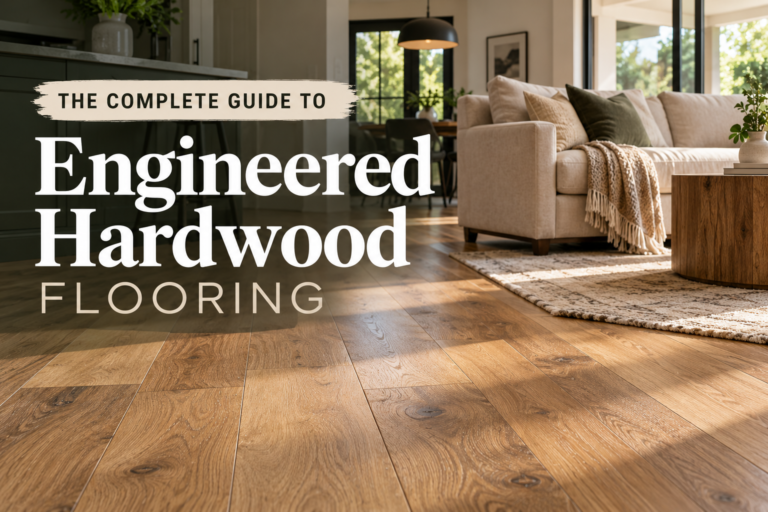
Best Basement Flooring Option #5: Engineered Hardwood
Engineered hardwood uses a real wood veneer over a plywood base, which makes it more dimensionally stable than solid hardwood in humid environments. It can handle the moderate moisture levels of a dry, well-controlled basement better than solid wood.
That said, it’s still not waterproof. If your basement has any history of water intrusion, engineered hardwood is not the right call. It belongs in basements that have excellent moisture control, no flooding history, and a proper vapor barrier installed over the concrete.
Pros:
- Genuine wood look and feel that no other product fully replicates
- More moisture-stable than solid hardwood
- Adds warmth and elegance to a finished basement
- Can contribute to home resale value
Cons:
- Not waterproof — still vulnerable to moisture damage
- Most expensive option per square foot
- Not appropriate for any basement with moisture concerns
- Can only be refinished once or twice before the veneer is too thin
Cost range: $8 to $15 per square foot installed
Best for: Dry basements only, with no flooding history and a confirmed moisture barrier. Best suited to basement living rooms and bedrooms in newer Utah homes with excellent drainage.
See our hardwood flooring options for available species and finishes.
What Should Never Go in a Basement
Solid hardwood is the one material that should never be installed in a basement under any circumstances. Wood absorbs moisture from the concrete slab and surrounding air, causing planks to swell, warp, cup, and eventually develop mold underneath. Even properly sealed solid hardwood will fail in a below-grade environment over time.
Standard (non-waterproof) laminate fails in basements because the inner core is made from compressed wood fiber that swells irreversibly when moisture seeps into the seams. The floor buckles, the planks separate, and the damage is typically not reversible.
Bamboo reacts severely to humidity changes and is not recommended for below-grade installations.
Quick Comparison: Basement Flooring at a Glance
| LVP | Tile | Waterproof Laminate | Carpet | Eng. Hardwood | |
| Waterproof | Yes | Yes | Yes | No | No |
| Comfort underfoot | Good | Poor | Good | Excellent | Excellent |
| Cost (installed) | $4–$10 | $7–$20 | $3–$8 | $3–$7 | $8–$15 |
| Durability | High | Very High | Medium | Low–Med | Medium |
| Flood recovery | Easy | Easy | Moderate | Very Difficult | Difficult |
| Lifespan | 15–25 yrs | 50+ yrs | 15–25 yrs | 5–15 yrs | 20–30 yrs |
| Best use | Any room | Wet areas | Living areas | Bedrooms | Dry basements |
Which Basement Flooring Is Right for Your Use Case?
Family room or living space: LVP is the safest and most versatile choice. It looks great, handles moisture, and is comfortable enough for everyday use.
Basement bedroom or guest suite: LVP or waterproof laminate for a clean look, or carpet tiles if maximum comfort is the priority and moisture is not a concern.
Home theater: Carpet tiles for the best acoustics and comfort, or LVP if you want easier maintenance.
Home gym: LVP handles equipment well. For heavy weightlifting areas, rubber flooring tiles over LVP or concrete offer the best floor protection and noise absorption.
Basement bathroom or laundry room: Tile only. No other material handles the concentrated moisture of these spaces as reliably.
Basement that has flooded before: LVP or tile exclusively. Do not install carpet, laminate, or engineered hardwood in a basement with any flooding history.
Frequently Asked Questions About Basement Flooring
What is the best flooring for a basement that floods?
LVP is the best option for basements with flooding history or active water risk. It’s fully waterproof, and floating-installation LVP can be lifted, dried, and reinstalled after a flood without replacing the material. Tile is equally waterproof but harder to reinstall. Carpet, standard laminate, and engineered hardwood should never be used in a basement that has flooded.
Do I need a vapor barrier under basement flooring?
In most cases, yes. A vapor barrier is a layer of heavy plastic sheeting installed between the concrete slab and your flooring. It blocks ground moisture from migrating up through the concrete and into your flooring material. Most LVP and laminate products require a vapor barrier over concrete, and some come with one attached to the underlayment. Your installer will assess your specific slab and recommend the right moisture protection.
Can you put hardwood floors in a basement?
Solid hardwood should never be installed in a basement. The moisture environment below grade will cause it to warp and fail over time regardless of sealing. Engineered hardwood is a better option for dry basements with no moisture history, but it still carries risk and requires a proper vapor barrier. If you want the look of hardwood in a basement, LVP is the more practical and durable solution.
How long does basement flooring typically last?
Lifespan varies by material and how well moisture is managed. Quality LVP typically lasts 15 to 25 years. Waterproof laminate runs 15 to 25 years. Carpet in a basement averages 5 to 15 years depending on moisture exposure. Tile can last 50 or more years. Engineered hardwood falls in the 20 to 30 year range in a well-controlled environment. In all cases, proper moisture management and professional installation extend the life of any basement floor significantly.
Is basement flooring installation different from other rooms?
Yes, in a few important ways. Concrete subfloors must be checked for moisture, cleaned, and leveled before installation. Most materials require a vapor barrier over the slab. Flooring also needs to acclimate to your basement’s temperature and humidity before installation — skipping this step can cause gapping or buckling after the floor is installed. Professional installation in a basement is particularly valuable because experienced installers know how to assess the slab, address problem areas, and ensure the floor performs as expected long-term.
Ready to Finish Your Basement? We Can Help.
Choosing the right basement flooring is one of the most important decisions in a basement renovation. Whether you’re finishing a family room, adding a bedroom, or converting the space into a home gym, Trademark Flooring will help you find the right material for your moisture levels, budget, and vision.
If you’re updating other areas of your home at the same time, check out our guides to kitchen flooring options and bathroom flooring options for the full picture.
We serve homeowners throughout Salt Lake City and the surrounding Utah area. Visit our local showroom to compare options in person, or request your free estimate today and we’ll guide you through every step.